Notes on Louis Riel
These notes come from The Canadian Encyclopedia and Wikipedia
 |
| Louis Riel at 14 |
 |
| Louis Riel |
 |
| Gabriel Dumont |
 |
| The Shooting of Thomas Scott. |
 |
| Big Bear |
 |
| Crowfoot |
Louis Riel's early life and background:
- Louis Riel was born in the Red River Settlement in 1844.
- Riel's father was a well respected member of the Metis community and had been involved with challenging the Hudson's Bay Company's monopoly of the fur trade.
- The Riel family was known to be devout Catholics and had strong family ties.
- Louis Riel was a very bright boy and was sent to study at the College de Montreal to be a priest
- He was considered to be an excellent student but was very moody and prone to bouts of anger
- Louis' father died in 1864 and because of his moodiness and because of his extreme reaction to the death of his father, the priests in the College and Louis himself, came to the conclusion that the priesthood was not for Louis.
- Louis chose to study law after that.
- During this time, Louis fell in love with a young woman named Marie-Julie Guernon. They were engaged but her family broke off the engagement because they didn't want their daughter to marry a Metis.
- Shortly after this Louis quit school and returned to the Red River.
Louis becomes political - the Red River Rebellion:
- When Louis Riel returned to the Red River he found that there had been a large number of English speaking, Protestant settlers that had come from Ontario.
- This caused religious, racial and political tensions between the Metis and the new settlers.
- At this time, Manitoba was not yet part of Canada. The land was part of Rupert's Land and belonged to the Hudson's Bay Company.
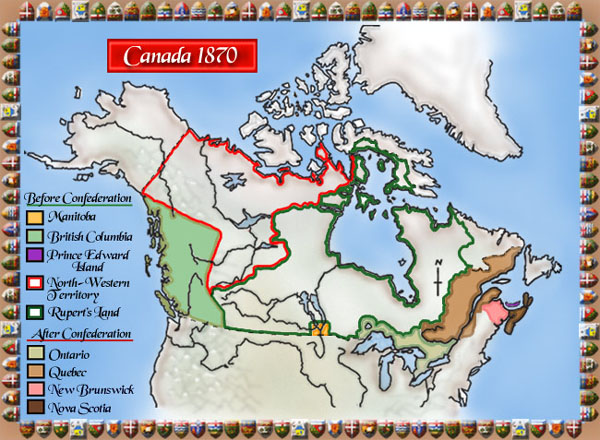 |
| Rupert's Land is outlined in green |
- The newly-formed Canadian government, led by Sir John A. Macdonald, appointed William McDougall to become Lieutenant-Governor of the new territory and to oversee the transfer of the land from the HBC to Canada.
- William McDougall was extremely anti-French and anti-Catholic and decided to start surveying the land before it had actually been turned over to Canada.
- Riel helped organize a group called the Metis National Committee which stepped in to interrupt the survey.
- Riel was called before the HBC to explain the Metis' actions and "Riel declared that any attempt by Canada to assume authority would be contested unless Ottawa had first negotiated terms with the Métis."
- The Metis stopped William McDougall from crossing the border from the US into Manitoba and on the same day, took control of the HBC Fort Garry.
 |
| Fort Garry was located just north of where Winnipeg is today. |
- Louis Riel invited both Metis and the English speaking settlers to come together and agree on a list of rights for the people of the Red River Settlement.
- Most English speaking people agreed with Riel but a small but passionate group of pro-Canadians formed the Canadian Party.
- the Canadian Party was led by John Christian Schultz, Colonel John Stoughton Dennis and a few others.
- McDougall authorized Colonel Dennis to raise a small army and Schultz recruited fifty men fortified his house and store with arms.
- Riel ordered Schultz's home surrounded, and the outnumbered Canadians soon surrendered and were imprisoned in Fort Garry.
- Métis National Committee declared a provisional government on 8 December, with Riel becoming its president on 27 December.
- Riel and Alexander Smith of the HBC worked together to create a peaceful solution but the members of the Canadian Party continued to plot against the provisional government.
- 48 men, members of the Canadian Party, including Thomas Scott, were arrested and held in Fort Garry.
- Most of these men were released but Thomas Scott was tried and found guilty of defying the authority of the provisional government and was sentenced to execution.
- The Canadian government sent militia under Colonel Wolseley to "lynch" Riel.
- Riel fled to the Dakota Territory which ended the Red River Rebellion.
- The Canadian government accepted the list of rights that Louis Riel had written and these became the basis of the Manitoba Act which led to Manitoba joining Confederation, but the Canadian government would not grant amnesty for the members of the provisional government.
- From the other side of the border, Riel ran as an independent for a seat in the House of Commons. Even though he was elected twice, he was never able to take his seat because of a $5000 bounty for his arrest.
- Eventually he was granted amnesty as long as he remained in exile for 5 years.
Riel's Exile and Struggle with Mental Illness:
- Following his political attempts to join Parliament, Riel spent the rest of his exile focusing more on religious matters than political ones.
- Riel began to believe that he that he was a divinely chosen leader of the Métis.
- Today, biographers and psychologists suspect that he suffered from megalomania.
- His mental state deteriorated, and following a violent outburst he was taken to Montreal, where he was under the care of his uncle fpr a few months but was eventually committed in an asylum.
- Believing he was the profit of the new world, he began to call himself Louis "David" Riel after King David of the Bible.
- He would pray (standing) for hours, having servants help him to hold his arms in the shape of a cross.
- He wrote many religious papers and frequently wrote about how, as the divinely chosen leader, he would create a place for all people regardless of religion or race to live equally.
- Eventually he was released and moved to Montana where he became a US citizen, married, raised a family and taught school.
The Return of Riel and the Northwest Rebellion:
- Many Metis moved into the Saskatchewan Valley hoping for a better life than in Manitoba but with the collapse of the buffalo herds the Metis, the Plains Cree, and the Blackfoot on the prairies were near starvation.
- There were many complaints about the Canadian government by the Metis, the First Nations and the Canadian and European settlers. The government was not responsive to the complaints.
- The Metis in Batoche sent a delegation led by Gabriel Dumont to ask Louis Riel to return to Canada and help them.
 |
| Batoche |
- Riel was convinced to return because he still believed he was the divinely chosen leader and prophet of the Metis.
- When he returned and spoke to the Metis and the English speaking settlers they were impressed with what Riel had to say.
- Over time Riel's unusual religious claims caused his support to lessen.
- Even so, he put together a petition and sent it to Ottawa.
- Riel began to pray obsessively and began to relapse into symptoms of his previous mental illness.
- When the Canadian government responded to the petition, they agreed to look into the problems listed.
- A small group of Metis believed that this was simply a delaying tactic by the government and, led by Riel, decided to take up arms.
- The numbers of the North West Mounted Police were increased in the area in response.
- The Metis cut telegraph wires between Battleford (where the NWMP were) and Batoche and formed a provisional government for Saskatchewan with Riel as the political and spiritual leader. Dumont became the military leader.
- Dumont and his men came across some of the NWMP near Duck Lake.
- A battle began between the NWMP and the Metis and the Plains Cree and the Blackfoot. This was the start of the Northwest Rebellion.
- The final Battle of Batoche ended very badly for the Metis and First Nations. Riel finally surrendered to the Canadian forces
Riel's Trial and Execution
- Riel was charged with treason - interestingly as at this point he was no longer a Canadian citizen.
- Riel's lawyers wanted Riel to plead insanity, however Riel refused. He stated, "Life, without the dignity of an intelligent being, is not worth having." He gave two long and impassioned speeches affirming the rights of the Metis and defending his own actions.
- Riel was found guilty, however the jury recommended mercy. Instead, the judge sentenced him to death and he was hanged on September 18, 1885.
- Fifty years later, one of the jurors from the trial said that Riel was tried for treason but hung for the death of Thomas Scott.
Important Vocabulary to Know:
amnesty
buffaloCanadian Party
Confederation
Constituency
delegation
execution
Fort Garry
HBC
William McDougall
megalomania
Metis
monopoly
pardon
prophet
provisional government
Rupert's Land
John Christian Schultz
Thomas Scott
survey
warrant
Colonel Garnet Wolseley


No comments:
Post a Comment