Colony of Vancouver Island
 |
| Flag for the Colony of Vancouver Island. |
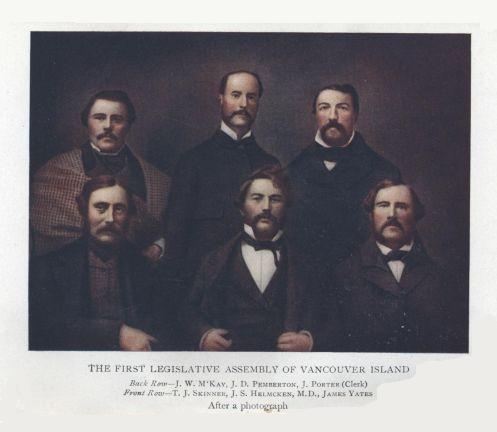
- in 1849 Vancouver Island became a crown colony .
- at first, James Douglas was in charge of encouraging British settlement.
- There was no civil service, no police, no militia, and virtually every British colonist was an employee of the HBC.
- In 1851 the colonial office appointed Douglas as governor.
- Douglas raised a domestic militia and worked hard at encouraging settlement.
- Mid-1850s, the colony's non-aboriginal population was approaching 500
- Sawmill and coal mining operations had been established at Fort Nanaimo and Fort Rupert (near present day Port Hardy).
- Douglas helped established a naval base at present-day Esquimalt to stop Russians and Americans from moving into Vancouver Island and BC
- Officials in London kept land prices high so that only the wealthier British would move to Vancouver Island & BC and they were were given incentives to bring out labourers with them to work the landholdings.
- Emigration was slow because of cost
- Most workers who didn't own land left VI to get free land in the US, or work in the California goldrush.
- VI had a large First Nations population > 30,000.
- Douglas negotiated fourteen separate treaties, the Douglas Treaties, with the various nations.
- The First Nations had to give up claim to all land within a designated area, except for villages and cultivated areas, in perpetuity (forever).
- They were also given permission to hunt and fish over unoccupied territories.
- For this, the First Nations were given a one-time cash payment of a few shillings each.
- By 1857, there were rumours of gold in the Cariboo.
- In 1858, 10,000-20,000 men moved into the interior of BC, and Victoria was transformed into a tent-city of prospectors, merchants, land-agents, and speculators.
- In 1858 - to control the HBC and the influx of people, the British government made BC a colony and offered the governorship of BC to James Douglas.
To see a birds-eye-view of what Victoria looked like in the early days, click here.
Colony of British Columbia
 |
| The Seymour Artillery Regiment in New Westminster, 1866 |
- The capital of British Columbia was New Westminster but Douglas governed from Victoria, the capital of Vancouver Island.
- Because of the Cariboo Gold Rush, there was a huge influx of people into the
- To control all the new people in BC & on VI, magistrates and constables were hired including "the Hanging Judge" - Matthew Baillie Begbie.
- Roads were constructed into the areas of greatest mining exploration around Lillooet and Lytton.
- A more stable population of British colonists settled in the region, establishing businesses, opening sawmills, and engaging in fishing and agriculture.

No comments:
Post a Comment