Search This Blog

Monday, June 4, 2012

Colonies of British Columbia and Vancouver Island

Colony of Vancouver Island 


Flag for the Colony of Vancouver Island.
  • in 1849 Vancouver Island became a crown colony . 
  • at first, James Douglas was in charge of encouraging British settlement. 
  • There was no civil service, no police, no militia, and virtually every British colonist was an employee of the HBC. 
  • In 1851 the colonial office appointed Douglas as governor. 
  • Douglas raised a domestic militia and worked hard at encouraging settlement.
  • Mid-1850s, the colony's non-aboriginal population was approaching 500
  • Sawmill and coal mining operations had been established at Fort Nanaimo and Fort Rupert (near present day Port Hardy). 
  • Douglas helped established a naval base at present-day Esquimalt to stop Russians and Americans from moving into Vancouver Island and BC
  • Officials in London kept land prices high so that only the wealthier British would move to Vancouver Island & BC and they were were given incentives to bring out labourers with them to work the landholdings. 
  • Emigration was slow because of cost
  • Most workers who didn't own land left VI to get free land in the US, or work in the California goldrush. 
  • VI had a large First Nations population > 30,000. 
  • Douglas negotiated fourteen separate treaties, the Douglas Treaties, with the various nations. 
  • The First Nations had to give up claim to all land within a designated area, except for villages and cultivated areas, in perpetuity (forever). 
  • They were also given permission to hunt and fish over unoccupied territories. 
  • For this, the First Nations were given a one-time cash payment of a few shillings each.
  • By 1857, there were rumours of gold in the Cariboo. 
  • In 1858, 10,000-20,000 men moved into the interior of BC, and Victoria was transformed into a tent-city of prospectors, merchants, land-agents, and speculators.
  • In 1858 - to control the HBC and the influx of people, the British government made BC a colony and offered the governorship of BC to James Douglas.
To see a birds-eye-view of what Victoria looked like in the early days, click here.


Colony of British Columbia
The Seymour Artillery Regiment in New Westminster, 1866

  • The capital of British Columbia was New Westminster but Douglas governed from Victoria, the capital of Vancouver Island.
  • Because of the Cariboo Gold Rush, there was a huge influx of people into the  
  • To control all the new people in BC & on VI, magistrates and constables were hired including "the Hanging Judge" - Matthew Baillie Begbie. 
  • Roads were constructed into the areas of greatest mining exploration around Lillooet and Lytton.
  • A more stable population of British colonists settled in the region, establishing businesses, opening sawmills, and engaging in fishing and agriculture.


Tuesday, May 29, 2012

Traditional Territory of the WSANEC People

Much of the information on this page comes from Saltwater People as told by Dave Elliott Sr. (citation below).

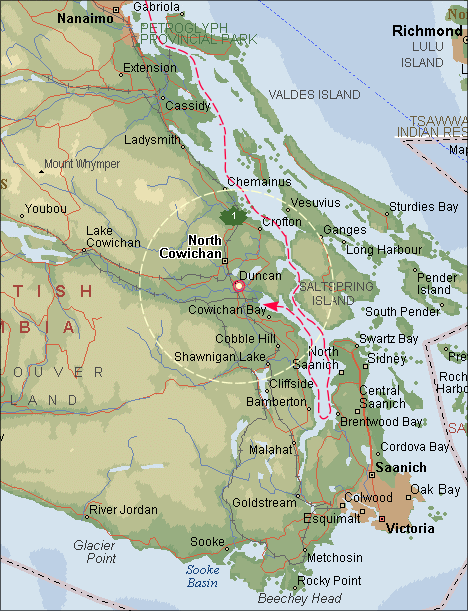
Have any of you wondered where the name Saanich comes from?  If you tell someone who isn't local that you live in Saanich, they often want to know how it is spelled, or if they see it written, they can't guess how to pronounce it.  In fact, the word Saanich is an anglicized version of the SENCOTEN word WSANEC which means "emerging people" and is the traditional name for this territory and the indigenous people who live here.

Most of us live in traditional WSANEC territory.


You probably could find Sidney, Pat Bay, Sidney Spit, or Butchart Gardens on a map.  But could you find KELSET, SKTAMEN, CUAN, or XEOLXELEK?


The ancestors of the WSANEC people have lived here since time beyond memory.  They are part of the Salish peoples - the biggest group of its kind in BC.  The Salish peoples can be found up Vancouver Island, down into Washington and up to the southern border of the Chilcotin country and to the Alberta border in the east.  Not all Salish people speak SENCOTEN but the WSANEC people and the people of the Cowichan Valley or the KHOWUTZUN people speak similar and related languages.  If you are interested in learning SENCOTEN a good place to start is on the First Voices website.

The WSANEC people passed their history down in an oral tradition by telling stories in families and in the long house.  By telling these stories, their children learned important lessons about who they were as a people, what they valued, and how they were expected to live their lives.


Think of a story that is passed down in your own family.  Why is it told over and over?  What purpose does this story hold for your family?  Is it funny?  Does it honour someone in your family?  Does it express an important part of your history?  Does it teach a lesson?


Traditional Place Names you should know:
  • W,SIKEM - "place of clay" - Tseycum
  • LAU,WEL,NEW - "place of escape" - Mt. Newton
  • WJOLELP - "place of maple leaves" - Tsartlip
  • BO,KECEN - "earth bluff" - Cole Bay
  • KELSET - "bailing" - Reay creek at Bazan Bay
  • TEL,ILCE - "place of the defeated" - Cordova Bay sand bar
  • S,TAUTW - "houses on top" - Tsawout
  • MA'LEXEL - "place of caterpillars" - Mill Bay ferry dock, Malahat
  • WSANEC - "emerging people" where the name Saanich comes from and the name of the Saanich people - Saanich Peninsula


Elliott, D. (1990). Saltwater people. Saanichton, BC: School District #63.

The Indian Act of 1876 Part 2

The Indian Act is a legal document and a set of laws that was passed by the Canadian government in 1876 that is still enforced today. This set of laws gave the government total control over the lives of the Indigenous people of Canada - it made Indigenous people wards of the state.
 
Historically, the British government had taken control over the Indigenous people.  Once Canada became a country, the responsibility was then passed on to the Canadian government.  Once the fur trade ended the Indigenous people had no role to play in settlement.  In fact, they were seen as a barrier to the government plans to the settlement of Western Canada.   The government referred to this as the "Indian Problem".

The government's response to this "problem" was to create the Indian Act.  The objectives to the Indian Act were to have control over the Indigenous people and to assimilate the Indigenous people into the dominant white culture.  In order to do this, the Indian Act gave the government complete control over Aboriginal politics, culture, education, and personal lives.  Indigenous peoples were not allowed to leave reserves, not allowed to own land, or not allowed to do business.  Also, the government decided who would be a "status Indian" and who would not.  Children were removed from families and placed into residential schools.  Financial control of Indigenous peoples were given to the federal government.  Aboriginal people were not given the vote until 1960.  The potlatch was banned in the 1880s and the sundance was banned until 1951.  It also banned fundraising for land claims support from 1921 - 1958.  The government established control over wills and burials.  All farming and trading businesses were controlled by the government.  Also, the government hired Indian agents to enforce the Indian Act.

While there are many negative aspects to the Indian Act, there are some positive aspects too.  The Indian Act is the only government document that exists that recognizes Aboriginal peoples.  Without the Indian Act, Indigenous people would not have any special status in terms of health services, education, subsidized housing, and exemptions from certain taxes.

Some amendments to the Indian Act have been made in either 1951 or 1985 including lifting the ban on ceremonies and fundraising, returning status to certain non status Aboriginal women and their children.  In spite of the amendments, much of the control of the Indigenous peoples remains with the government through the Indian Act.

(From Shared Learnings: Integrating BC Aboriginal Content K-10)


Take on a character from 1876.  Are you Metis?  Are you a First Nations woman or man?  Are you a settler?  Write a letter to the editor about the Indian Act.  Due Friday.

The Indian Act of 1876 Part 1

The Indian Act, 1876 In 1876 the new government of Canada passed the Indian Act which changed and pulled together all previous laws concerning the Indigenous people of Canada. Notably, this act turned the Aboriginals into legal wards of the state. 


Definition: In law, a ward of the state is someone placed under the protection of a legal guardian, in this case the government. A court may take responsibility for the legal protection of an individual, usually either a child or incapacitated person.  


Question: What attitudes do you think the government held about the Indigenous people of Canada?


The Indian Act also defined what the government considered to be an "Indian".  For example:


  • Any woman that married an Aboriginal man could be considered an Indian and could be allowed to live and even be buried on a reserve. These women also received other cultural and social benefits by gaining Indian status. However, any Aboriginal woman who married a white, European male was now considered to be a bona fide member of Canadian society. She lost her Indian status and every right that came with it.
  • All "half-breed" Indians, like the Metis, were not entitled to Indian status. This included Métis who had received scrip - transferable land or cash allowances that were issued on paper certificates. (from http://www1.canadiana.org/citm/themes/aboriginals/aboriginals8_e.html)
Even Sir John A. Macdonald, the first Prime Minister of Canada, said "If they are half-breed, they are [considered by the government to be] white."


Read what Alexander Morris recommended regarding "half breeds". Click here.


Questions:  Why is the term "half breed" so offensive?  What type of thinking does it indicate the early leaders of Canada held about the Metis?
What do you think about the government defining what made one person a "status Indian" and another not?  Is this still a concern today?  What do you think?
Look at the first example given about women and their status.  Many people consider there are a number of problems with this thinking.  What would you consider the problems to be?  When would you guess this part of the Indian Act was changed?


The Indian Act also created rules about the sale of Aboriginal lands. The government could issue licenses allowing timber to be cut and removed from these properties. In other world, the Indigenous peoples were given lands to live on but did not have control over the resources on the lands.


As of 1876, there were legal punishments for Indigenous peoples who left reserves or sold liquor on reserves.  Following the 1876 Indian Act, Aboriginals who lived on reserves were forced to carry an identity card, like a passport, every time they stepped off reserve land.
The act was rewritten in 1951 and revised again in 1985. However, many provisions - including ones prohibiting Aboriginals from living on land outside of reserves or from drinking - have since been repealed or have simply fallen into disuse.

(from http://www1.canadiana.org/citm/themes/aboriginals/aboriginals8_e.html)


Monday, May 28, 2012

Elections - Who was Louis Riel?


STEPS TO FOLLOW FOR AN ELECTION

Campaigning
Divide into 1 of 4 groups, representing what you think about Louis Riel. Each group should choose a spokesperson.  Help your spokesperson put together a short speech about why the class should vote that Louis Riel is a hero, traitor, visionary or madman.  
Each candidate should then make a brief speech and there will be a period for a short press conference to answer questions.

Voting procedure
We will choose a deputy returning officer and poll clerk and they will swear the oath. 

I solemnly affirm that:

–   I have reached voting age;
–   I live in the riding of _______________ (give the name of the school);
–   I will act faithfully without partiality, fear, favour or affection and in every respect according to the law;
–   at the polling station, I will maintain the secrecy of the vote.


The deputy returning officer will show everyone that the ballot box is empty. The deputy returning officer then closes and seals the box.
Tell the group how to go about voting:
  • Electors come forward one by one and state their name and address (in this case, their class/grade) clearly and the poll clerk locates the elector's name on the list.
  • The deputy returning officer then asks for the elector's ID and if it matches the voters list, the poll clerk crosses out the elector's name on the list.
  • The deputy returning officer then gives them each a folded ballot.
  • Each elector-student in turn then goes directly behind the voting screen and marks the ballot with a pencil.
  • Any elector who makes a mistake while marking the ballot can ask the deputy returning officer for another one. The first is then regarded as a "spoiled ballot" and is set aside with the rest of the spoiled ballots.
  • Once the elector has marked his ballot he/she then places the ballot in the ballot box.
  • The deputy returning officer and poll clerk have the opportunity to vote before opening the polling station.

Counting the vote
After everyone has voted, the votes are counted. The deputy returning officer opens the sealed ballot box and empties it onto the table.
He then unfolds the ballots one by one, calls out the name of the candidate for whom it has been marked, and shows the ballot to the poll clerk. On the tally sheet, the poll clerk checks off a box under the name of the choice selected on each ballot. The deputy returning officer places the counted ballots cast for each choice in separate piles. After counting, he also checks whether the number of votes recorded on the tally sheet by the poll clerk corresponds to the number of ballots in each candidate's pile. Ballots are rejected if marked incorrectly. Make separate piles for rejected ballots and spoiled ballots (i.e. any ballot incorrectly marked by the elector and exchanged for another one).
The deputy returning officer and the poll clerk must fill out the Statement of Votes. Explain to the group that the number of valid, spoiled, rejected and unused ballots must be equal to the number of ballots you had before the election, and that this must be checked to prevent fraud.
After the votes have been counted, the results of the election will be announced to the class, stressing that in a democracy, everyone wins.

Louis Riel


Notes on Louis Riel

These notes come from The Canadian Encyclopedia and Wikipedia


Louis Riel at 14
Louis Riel


Gabriel Dumont


The Shooting of Thomas Scott.


Big Bear


Crowfoot


Louis Riel's early life and background:

  • Louis Riel was born in the Red River Settlement in 1844.
  • Riel's father was a well respected member of the Metis community and had been involved with challenging the Hudson's Bay Company's monopoly of the fur trade.
  • The Riel family was known to be devout Catholics and had strong family ties.
  • Louis Riel was a very bright boy and was sent to study at the College de Montreal to be a priest
  • He was considered to be an excellent student but was very moody and prone to bouts of anger
  • Louis' father died in 1864 and because of his moodiness and because of his extreme reaction to the death of his father, the priests in the College and Louis himself, came to the conclusion that the priesthood was not for Louis.
  • Louis chose to study law after that.
  • During this time, Louis fell in love with a young woman named Marie-Julie Guernon.  They were engaged but her family broke off the engagement because they didn't want their daughter to marry a Metis.
  • Shortly after this Louis quit school and returned to the Red River.


Louis becomes political - the Red River Rebellion:

  • When Louis Riel returned to the Red River he found that there had been a large number of English speaking, Protestant settlers that had come from Ontario.
  • This caused religious, racial and political tensions between the Metis and the new settlers.
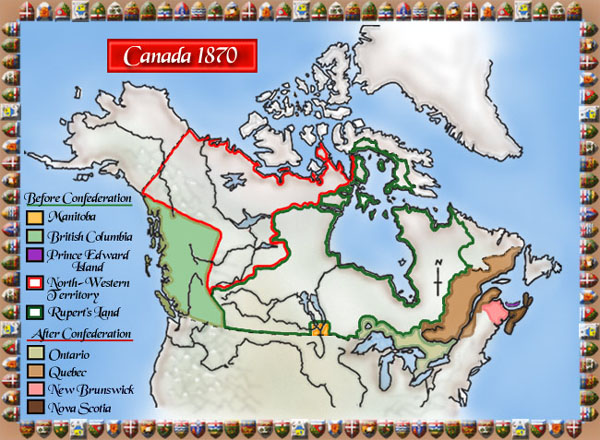
  • At this time, Manitoba was not yet part of Canada.  The land was part of Rupert's Land and belonged to the Hudson's Bay Company.

Rupert's Land is outlined in green

  • The newly-formed Canadian government, led by Sir John A. Macdonald, appointed William McDougall to become Lieutenant-Governor of the new territory and to oversee the transfer of the land from the HBC to Canada.
  • William McDougall was extremely anti-French and anti-Catholic and decided to start surveying the land before it had actually been turned over to Canada.
  • Riel helped organize a group called the Metis National Committee which stepped in to interrupt the survey.
  • Riel was called before the HBC to explain the Metis' actions and "Riel declared that any attempt by Canada to assume authority would be contested unless Ottawa had first negotiated terms with the Métis."
  • The Metis stopped William McDougall from crossing the border from the US into Manitoba and on the same day, took control of the HBC Fort Garry.

Fort Garry was located just north of where Winnipeg is today.
  • Louis Riel invited both Metis and the English speaking settlers to come together and agree on a list of rights for the people of the Red River Settlement.
  • Most English speaking people agreed with Riel but a small but passionate group of pro-Canadians formed the Canadian Party.
  • the Canadian Party was led by John Christian Schultz, Colonel John Stoughton Dennis and a few others.
  • McDougall authorized Colonel Dennis to raise a small army and Schultz recruited fifty men fortified his house and store with arms. 
  • Riel ordered Schultz's home surrounded, and the outnumbered Canadians soon surrendered and were imprisoned in Fort Garry.
  • Métis National Committee declared a provisional government on 8 December, with Riel becoming its president on 27 December.
  •  Riel and Alexander Smith of the HBC worked together to create a peaceful solution but the members of the Canadian Party continued to plot against the provisional government.
  • 48 men, members of the Canadian Party, including Thomas Scott, were arrested and held in Fort Garry.
  • Most of these men were released but Thomas Scott was tried and found guilty of defying the authority of the provisional government and was sentenced to execution.
  • The Canadian government sent militia under Colonel Wolseley to "lynch" Riel.
  • Riel fled to the Dakota Territory which ended the Red River Rebellion.
  • The Canadian government accepted the list of rights that Louis Riel had written and these became the basis of the Manitoba Act which led to Manitoba joining Confederation, but the Canadian government would not grant amnesty for the members of the provisional government.
  • From the other side of the border, Riel ran as an independent for a seat in the House of Commons.  Even though he was elected twice, he was never able to take his seat because of a $5000 bounty for his arrest. 
  • Eventually he was granted amnesty as long as he remained in exile for 5 years. 

Riel's Exile and Struggle with Mental Illness:


  • Following his political attempts to join Parliament, Riel spent the rest of his exile focusing more on religious matters than political ones.
  • Riel began to believe that he that he was a divinely chosen leader of the Métis.
  • Today, biographers and psychologists suspect that he suffered from megalomania. 
  • His mental state deteriorated, and following a violent outburst he was taken to Montreal, where he was under the care of his uncle fpr a few months but was eventually committed in an asylum.
  • Believing he was the profit of the new world, he began to call himself Louis "David" Riel after King David of the Bible.  
  • He would pray (standing) for hours, having servants help him to hold his arms in the shape of a cross.
  • He wrote many religious papers and frequently wrote about how, as the divinely chosen leader, he would create a place for all people regardless of religion or race to live equally.
  • Eventually he was released and moved to Montana where he became a US citizen, married, raised a family and taught school.

The Return of Riel and the Northwest Rebellion:


  • Many Metis moved into the Saskatchewan Valley hoping for a better life than in Manitoba but with the collapse of the buffalo herds the Metis, the Plains Cree, and the Blackfoot on the prairies were near starvation.
  • There were many complaints about the Canadian government by the Metis, the First Nations and the Canadian and European settlers.  The government was not responsive to the complaints.
  • The Metis in Batoche sent a delegation led by Gabriel Dumont to ask Louis Riel to return to Canada and help them.

Batoche


  • Riel was convinced to return because he still believed he was the divinely chosen leader and prophet of the Metis.
  • When he returned and spoke to the Metis and the English speaking settlers they were impressed with what Riel had to say.
  • Over time Riel's unusual religious claims caused his support to lessen.
  • Even so, he put together a petition and sent it to Ottawa.
  • Riel began to pray obsessively and began to relapse into symptoms of his previous mental illness.
  • When the Canadian government responded to the petition, they agreed to look into the problems listed.
  • A small group of Metis believed that this was simply a delaying tactic by the government and, led by Riel, decided to take up arms.
  • The numbers of the North West Mounted Police were increased in the area in response.
  • The Metis cut telegraph wires between Battleford (where the NWMP were) and Batoche and formed a provisional government for Saskatchewan with Riel as the political and spiritual leader.  Dumont became the military leader.
  • Dumont and his men came across some of the NWMP near Duck Lake. 
  • A battle began between the NWMP and the Metis and the Plains Cree and the Blackfoot.  This was the start of the Northwest Rebellion.
  • The final Battle of Batoche ended very badly for the Metis and First Nations.  Riel finally surrendered to the Canadian forces


Riel's Trial and Execution


  • Riel was charged with treason - interestingly as at this point he was no longer a Canadian citizen.
  • Riel's lawyers wanted Riel to plead insanity, however Riel refused.  He stated, "Life, without the dignity of an intelligent being, is not worth having."  He gave two long and impassioned speeches affirming the rights of the Metis and defending his own actions.
  • Riel was found guilty, however the jury recommended mercy.  Instead, the judge sentenced him to death and he was hanged on September 18, 1885.
  • Fifty years later, one of the jurors from the trial said that Riel was tried for treason but hung for the death of Thomas Scott.


Important Vocabulary to Know:

amnesty
buffalo
Canadian Party
Confederation
Constituency
delegation
execution
Fort Garry
HBC
William McDougall 
megalomania
Metis
monopoly
pardon
prophet
provisional government
Rupert's Land
John Christian Schultz
Thomas Scott
survey
warrant
Colonel Garnet Wolseley


Monday, May 21, 2012

Metis in Canada

We are about to learn about Louis Riel.  Louis Riel was an early leader of the Metis.


What does this symbolize?


Who are the Metis?


As we read through the linked page, answer the following questions:


  1. What is the definition that is accepted today for a Metis person?
  2. What is the historic Metis nation homeland?
  3. What is the Metis nation?
  4. What is the historical definition for the term Metis?
  5. What was the original role and occupations of the Metis?
  6. What was their territory?
  7. Describe where original Metis culture came from.
  8. Describe examples of early Metis culture and inventions.
  9. Metis were expert hunters which helped them become _______.
  10. How did the Metis govern themselves?
  11. What important role did Louis Riel play in the creation of Canada?
  12. Why did the Metis stand up against the government at Batoche (North-west Saskatchewan)?
  13. What is the picture above and what does it symbolize?